The Racing Shoe Specialist (2)
◁ Previously: Click here for the story (1)
Back to the Track
Let us return, then, to motorsport — and to the shoes that shaped it.
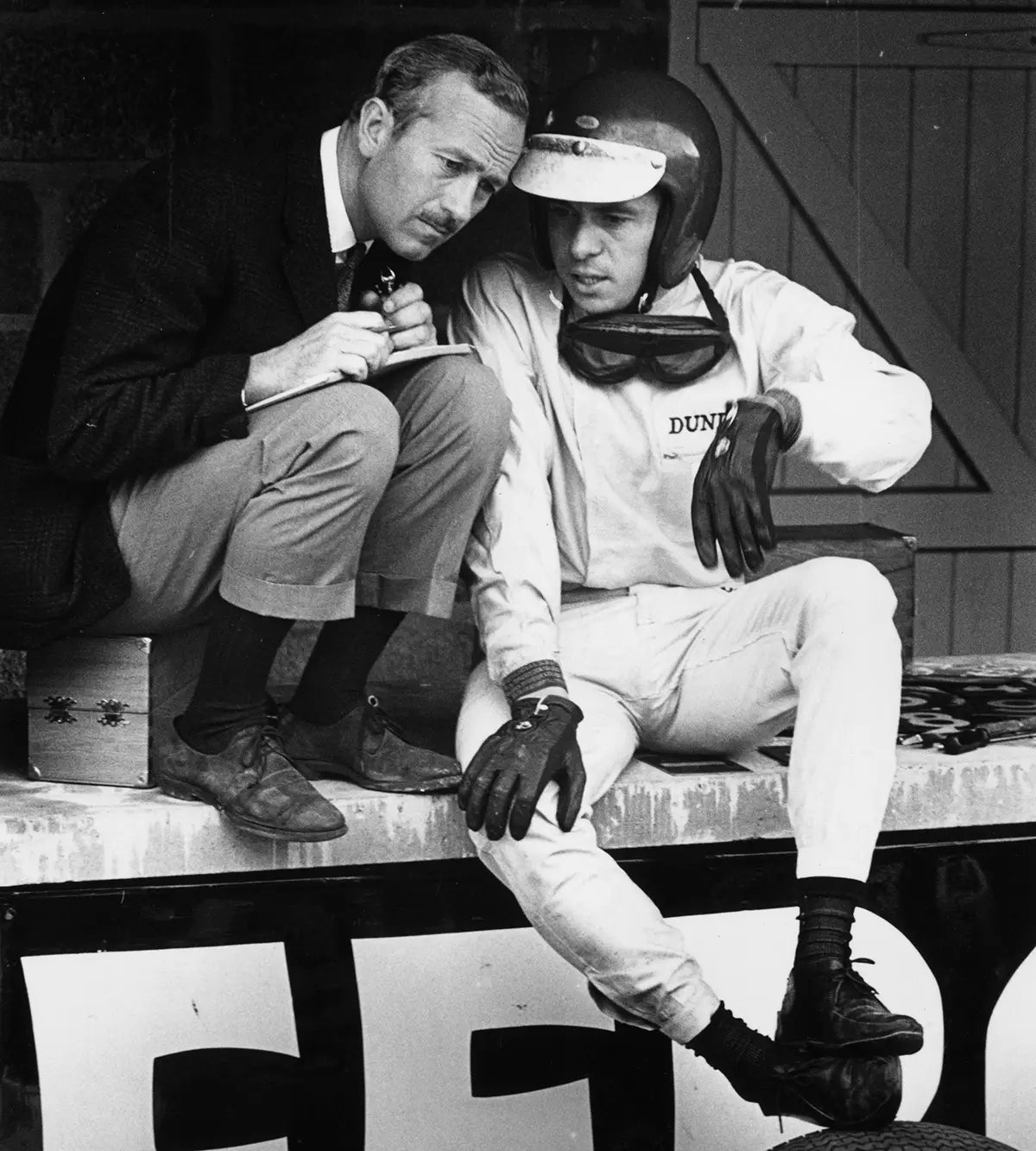
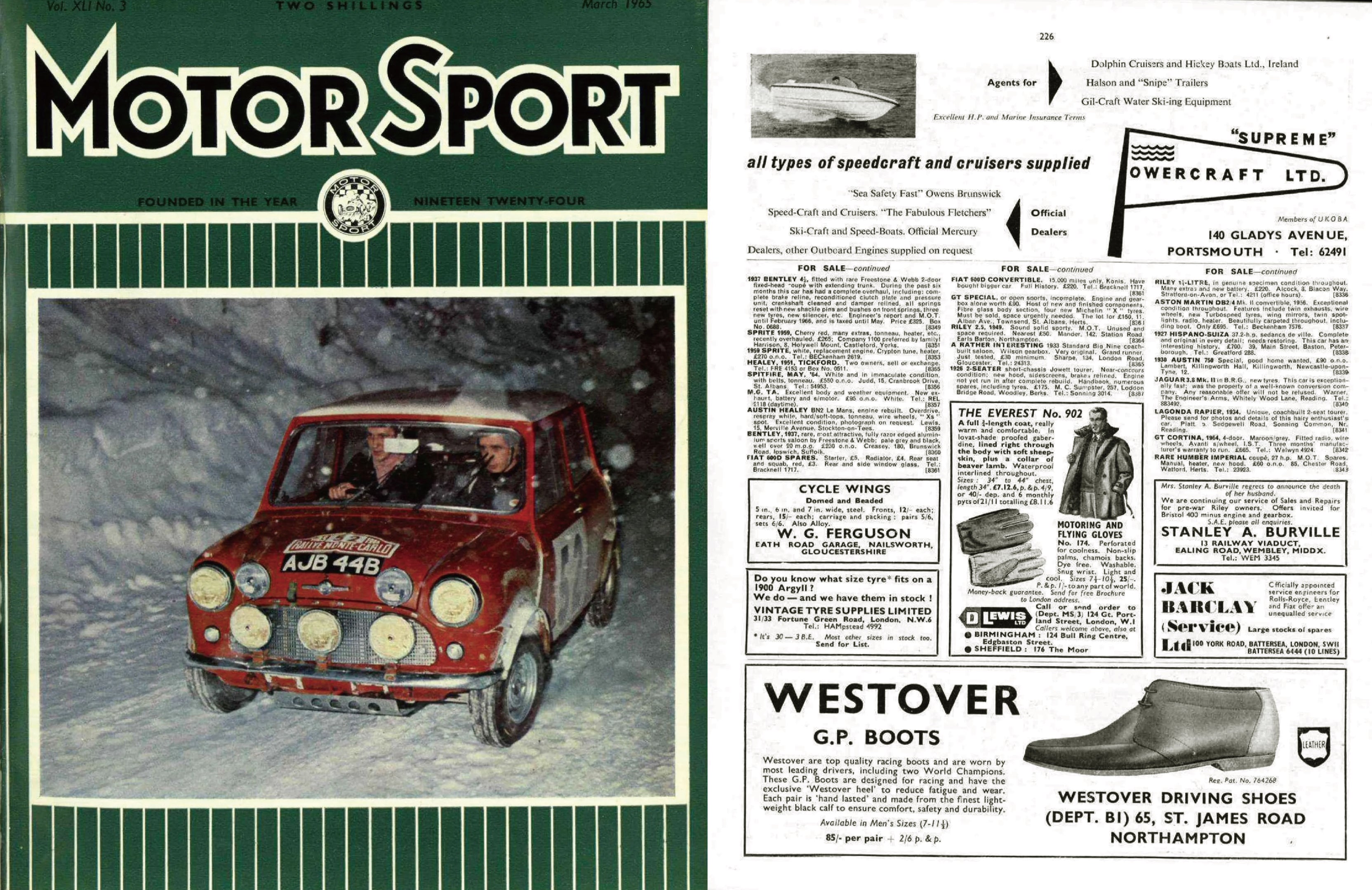
The chukka-style racing boot pictured on the opposite page first appeared in a British motoring magazine advertisement in March 1965. It featured two distinctive pairs of eyelets, a slim leather sole, and a heel cut into a concave “Westover” shape — unmistakably the same design seen on Jim Clark’s feet in that now-iconic photograph.
The advertisement bore the name WESTOVER DRIVING SHOES, with the model identified as the G.P. Boots. The accompanying text proclaimed that “Westover produces racing boots of the highest quality, worn by most leading drivers — including two World Champions.” Such wording leaves little doubt: by the time this advertisement ran, the G.P. Boots had already found their place on the Grand Prix grid.
The company’s address placed it in Northampton — the spiritual home of British shoemaking. But that raises an intriguing question: who exactly was behind the Westover Driving Shoes Company?
 ©︎Motor Sport Magazine | September 1963
Westover Driving Shoes
While combing through back issues of Britain’s long-established Motor Sport magazine, I came across the earliest known record of an advertisement from Westover, printed in the September 1963 issue. The shoe featured there was not yet a purpose-built racing model, but a slender slip-on driving shoe distinguished by a heel wrapped in bend leather — a refined yet functional detail.
From this, it becomes clear that Westover was already active as a dedicated driving-shoe brand by 1963. More significantly, this appears to have been the very first advertisement in Motor Sport to use the term “driving shoes”, regardless of brand or design.
In later years, renowned motoring accessory houses such as Les Leston and Ogden Smith would release their own driving footwear, but the evidence suggests that Westover was there first — the true pioneer of the driving-shoe genre.

The Tourer
Continuing through the Motor Sport archives, one finds that Westover introduced a new model in the Christmas issue of 1965 — a suede driving shoe named the Tourer.
Where the G.P. Boots had been crafted from soft black calf and carried the air of professional equipment, the Tourer presented a more relaxed character. Its collar was cut narrower, the uppers made from brown suede, and the heel constructed in contrasting saddle leather. The description noted a wraparound heel — a thoughtful detail designed to make pivoting easier when driving.
Throughout 1966 and into 1967, the Tourer appeared regularly in the magazine’s pages. The advertisements mention a made-to-order service and even a range of ladies’ sizes — small clues that Westover’s vision for driving shoes was expanding beyond the circuit, into something more personal and refined.
The G.P. Boots on the Circuit
Tracing the footwear seen around the Formula One paddocks of the 1960s, one finds Westover’s racing shoes everywhere. The brand’s presence was unmistakable — its name quietly stamped into the fabric of the era.
Among the most notable wearers were two world champions: Jim Clark, crowned in 1960, and Graham Hill, the 1961 champion. Photographs and race reports alike suggest that both men could almost always be seen at the circuit wearing Westover shoes — a subtle but consistent detail in the visual language of Grand Prix racing at the time.

24 September 1963 ©︎PA IMAGES | Alamy
Jim Clark, 1963
This photograph, taken on 24 September 1963, shows Jim Clark seated casually on the rear tyre of his Lotus Formula One car. The original caption offers little detail, yet judging from the Team Lotus emblem and the date, it is most likely the Lotus 25, powered by the Coventry Climax engine.
That season marked a defining moment: Clark and Team Lotus achieved their first World Championship title with commanding dominance. What makes this image particularly remarkable, however, is the clarity with which his footwear can be seen — in full colour, every detail visible.
The shoes unmistakably match the form of the Westover G.P. Boots, confirming that by 1963 the model was already in existence — a quiet testament, captured at the height of one of racing’s most glorious years.

Goodwood Sunday Mirror Trophy Race. 15th April 1966. ©︎Trinity Mirror | Alamy
Graham Hill, Goodwood, 1966
Graham Hill rests a foot upon the tyre, his expression composed yet resolute — a portrait of quiet determination.
The scene is Goodwood Circuit, April 1966.
On the toe of his G.P. Boots, one can see the rough scarring left by the pedals — marks earned in the heat of the race.
There is a purity to this simplicity, a beauty that belongs to another age — the kind of style no longer seen on today’s circuits.

French Grand Prix, Rouen, 1968 24 September ©︎Heritage Image Partnership Ltd | Alamy
Graham Hill, Rouen-Les-Essarts, 1968
Graham Hill watches his mechanics with a solemn, almost meditative gaze.
The place is Rouen-Les-Essarts, September 1968 — the scene of that year’s French Grand Prix.
It was a season of change. Team Lotus had just ushered in a new era for Formula One by introducing the sport’s first full commercial sponsorship. Hill took to the grid in the Lotus 49B, resplendent in the Gold Leaf colours of Imperial Tobacco — a bold departure from the racing greens of old Britain.
The race would end in retirement for Hill, yet the image endures: a champion standing at the threshold between two worlds — the age of pure racing spirit, and the dawn of corporate speed.